The public record, kept properly.
Professional file preparation, records management and district website management for public boards. Record your meeting and share it with us. We prepare every document to your bylaws and your state’s open meeting requirements, then file and post it on schedule.
One provider, end to end
Every step of the public record, in one set of hands
Most districts piece this together from a minutes service, a website vendor and whoever has time. We carry the record the whole way, from the recording to the public website to the archive, so nothing falls into a gap between vendors.
Record
Hold the meeting as usual and upload the recording.
The districtDraft
Minutes, the next agenda, notices and resolutions.
We prepareCheck
Every motion and vote reviewed against the recording.
We reviewSign
Your officer of record reviews and signs.
The districtPost
Published to your district website on schedule.
We postFile
Filed to the state retention schedule.
We file
Arizona special districts
A proud ASDA Preferred Partner
The Board Secretary is an ASDA Preferred Partner of the Arizona Special Districts Alliance. We help special districts across Arizona keep their meetings, notices and records in line with the state’s open meeting law, every month, without adding staff.
Arizona’s open meeting law runs on tight timelines. Notices and agendas generally have to be posted at least 24 hours before a meeting, and minutes or a recording must be open to the public within three working days afterwards. We build each district’s calendar around those timelines and prepare the documents to meet them.
For ASDA members
10% off
ASDA member districts receive 10% off their first 12 months of paid service, on top of the free first month.
In plain terms
Three steps, every month
The district’s part takes minutes. Ours takes the rest of the month.
You record the meeting
Run your board meeting the way you always have. Record it on any device and upload the recording. That is the whole job on your side.
We prepare the documents
Minutes with each motion as stated, the mover, the seconder, each member’s vote and an action list. Then the next agenda, hearing notices and resolutions, prepared to your bylaws and your state’s requirements.
Your officer signs, we post
Drafts are scheduled to reach your officer of record ahead of the posting deadline. Once signed, we post the record to your district website and file it in your records hub.
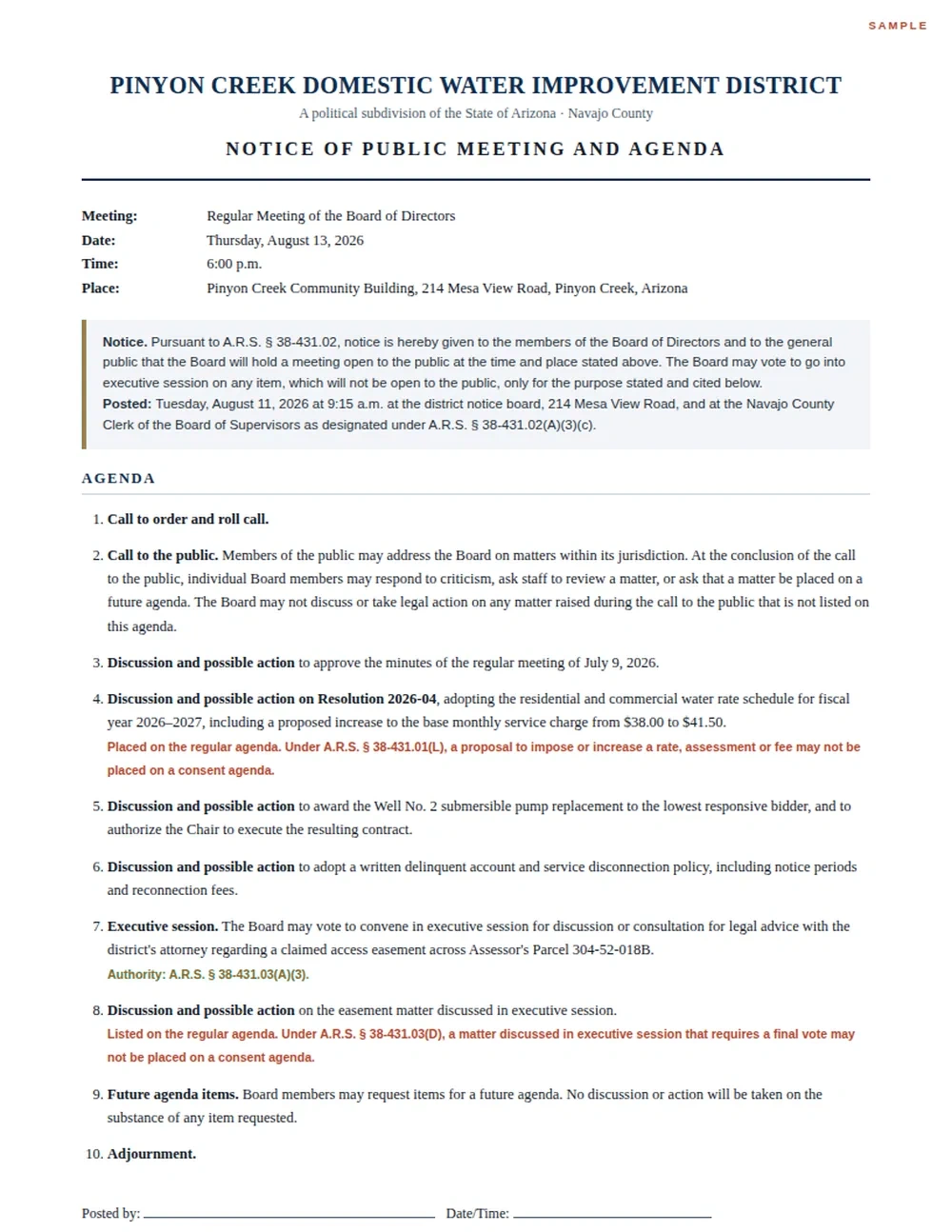
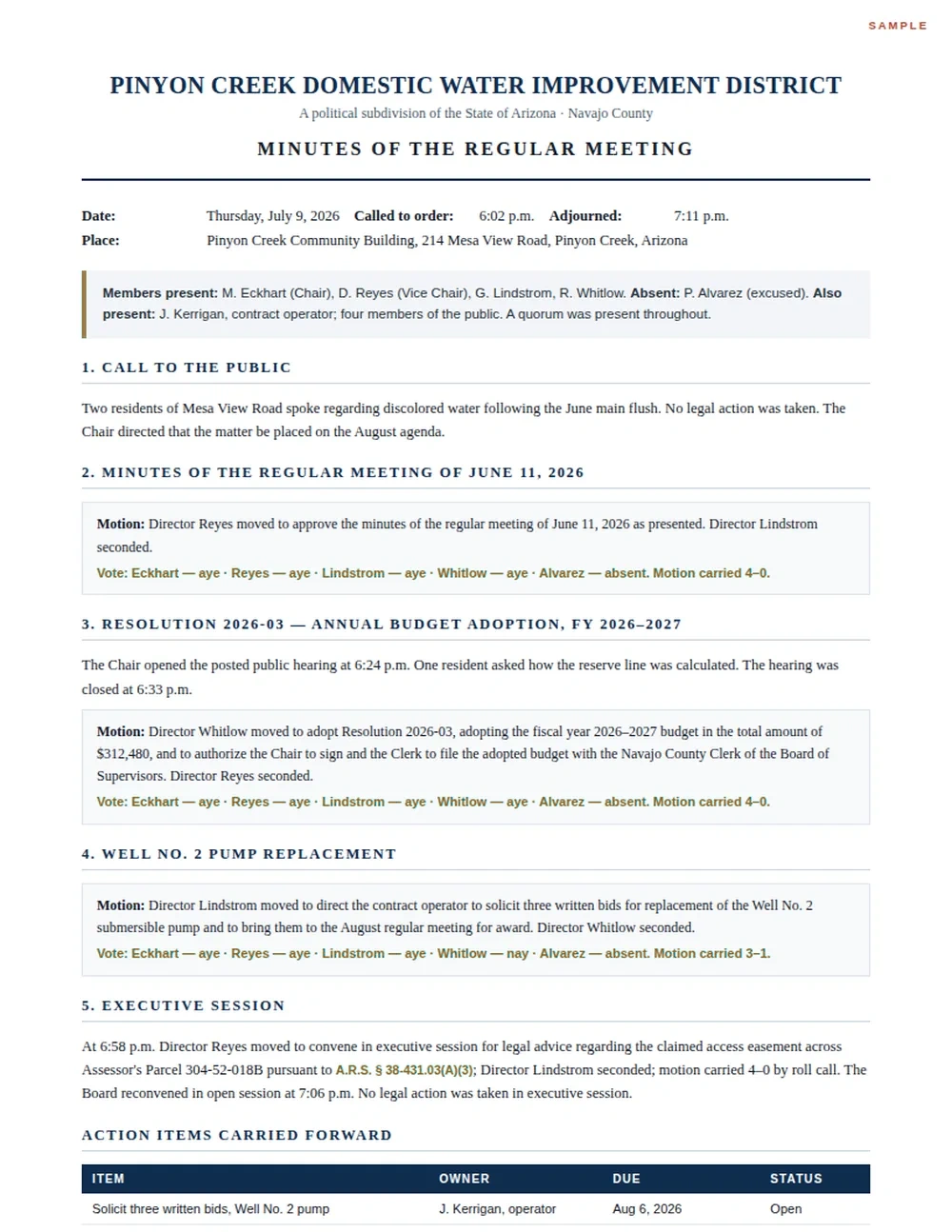
Sample documents
Read the actual work
These are the first pages of a sample agenda and sample minutes, prepared for a fictional district. Your documents are prepared to your own state’s open meeting law and your own state’s retention schedule.
Sample documents for a fictional district. Statutory citations are shown as placeholders.
Where we work
Anywhere in the United States, prepared to your state’s rules
There are 39,555 special district governments in the United States, and every state has its own open meeting law. Before the first meeting we work on, we review your state’s law, its retention schedule and your bylaws, and confirm a dated calendar in writing. Where common practice and the statute differ, we work to the stricter reading.
Four obligations found in most states
Posted a minimum time before the meeting.
Open to the public within a set period afterwards.
Held only under a specific statutory exemption.
Kept on a published retention schedule.
The deadlines, citations and retention periods differ by state. Yours are confirmed in writing during onboarding, before the first meeting we work on. This is general information, not legal advice. District count: U.S. Census Bureau, 2022 Census of Governments.
The reminder system
A calendar that does not depend on memory
Scheduled email reminders run on a fixed monthly rhythm: agenda items due, drafts ready with the post-by date, and a confirmation once the record is posted.
The cycle runs on the calendar we confirm with you, so no single person has to remember it. Budget season, hearing notices and election cycles come around on the same schedule every year, and the reminders run from that annual calendar too.
The Board SecretaryAug 10, 9:00 AM
Reminder: agenda items for your Aug 20 meeting 7 days out
Anything new for the agenda? Reply to this email with items by Friday and the draft will include them, so nothing has to be added at the last minute.
The Board SecretaryAug 14, 8:15 AM
Your drafts are ready: post by Sunday 6:00 PM Action needed
The Aug 20 agenda and the July 16 minutes are attached and in your folder. Review, sign and reply “approved,” and posting is handled from there.
The Board SecretaryAug 16, 4:30 PM
Posted: your meeting records are up to date Done
The signed agenda is posted to the website and the posting certificate is in your folder, 72 hours ahead of the deadline. Nothing left to do.
What districts told us
Built around what a chief and a clerk actually do each month
This service was shaped by conversations with fire chiefs, district clerks and office administrators. These six points shaped it most.
Minutes take a full day each month
Recording, transcribing, correcting, writing, posting, sending to the attorney and copying the board can take the better part of a day. We give that time back. The district shares one recording, and we handle the rest.
Recordings nobody can open
Proprietary recorder files often will not play on a Mac, a phone or an older PC. We convert each recording to a standard audio format and post it beside the written minutes.
A transcript is not a record
A raw transcript can mishear names, titles and motions. Every draft is reviewed against the recording, and anything unclear is flagged with a timestamp for the district to confirm rather than guessed.
Compliance questions follow complaints
When a complaint is filed, the agenda wording, the posting record and the vote record are read closely. We prepare every document with that reader in mind.
The year repeats
Budget season, hearing notices and election cycles come around every year. We build the district’s annual calendar once, and the reminders run from it.
Residents have a right to read
Audio alone does not serve residents who are hard of hearing or cannot play the file. Written minutes posted beside the audio serve both, and support the federal accessibility standard.
What boards ask for before they decide. Because open meeting laws generally limit how a board discusses business outside a noticed meeting, the chief or clerk usually presents this to the board. We provide a short summary for the board, a signed confidentiality agreement before the first file, a service agreement the district’s attorney can review, and a free first month so the board can judge work it has actually seen.
Public meetings
Board Meetings & Records
The meetings page stays current: signed records are posted on your calendar.
Managed district websites
Your district website, fully managed
The record is only useful once the public can find it. We design, host, secure and maintain the district website, keep it accessible, and post every signed record to it on schedule.
We build and manage websites for a wide variety of business owners, and district sites get the same hands-on care: design, hosting, security, search visibility and ongoing updates, all handled for you.
A district site that residents cannot read is a compliance concern, not a cosmetic one. Once your officer of record signs, we post the record. Board members do not need to edit a webpage.
Sites are built to WCAG 2.1 Level AA, the technical standard the U.S. Department of Justice adopted for state and local government web content under Title II of the ADA. The compliance date for special district governments is April 26, 2028. The rule and the dates →
Design and build
A clean, readable district site built around what residents look for: meetings, records, notices, contacts and service information. Built in your district’s colors, with the content carried over from your current site.
Hosting and security
Fast, secure hosting with encrypted connections, security headers and ongoing monitoring. Every change is tracked, so any edit can be reviewed or rolled back.
Accessibility, checked
Pages and posted documents are built and checked to WCAG 2.1 Level AA, the standard the U.S. Department of Justice adopted for state and local government web content.
Meetings page kept current
Agendas, notices and signed minutes are posted on your calendar, in order, with past records archived where residents can find them.
Changes through one link
New photos, staff changes, notices or corrections are sent through the district’s private request link. We make the change and confirm when it is live.
Domain and district email
We manage the domain records and keep the district email addresses tied to the site working. Your district keeps ownership of the domain at all times.
The budget question
One provider, one written quote
A board adopts a budget and then answers for it in public. Every engagement is quoted to the district in writing after the free first month, sized to its meeting calendar and document volume, so the board knows exactly what it is approving before it votes.
We do not publish a rate card. A one-station district and a growing authority carry very different workloads, so each quote is built from what we learn during the free first month.
Document drafting, a website vendor, accessibility remediation, and records and filing help: several contracts with gaps between them. One provider closes those gaps.
Skilled administrative work a few days a month is hard to staff as a position. A service engagement provides that capacity without adding one.
Where we stop
Clear boundaries, on every engagement
The board’s Secretary stays the Secretary, and the district’s attorney stays the attorney. We prepare the paperwork behind them and stay within these lines.
Your elected and appointed officers hold their offices. We support them.
Legal questions go to the district’s attorney.
Public money never passes through our hands.
Elections stay with the officials the law assigns them to.
The Board Secretary provides administrative document preparation and board-secretary support. It does not provide legal advice, hold public funds, or serve as a statutory officer; legal questions are referred to the district’s attorney.
Our review desk
Specialists behind every record
Every engagement draws on four areas of expertise, and every document passes through a structured review before it reaches your officer of record.
Records and client management
Your district’s records hub, filing to the state retention schedule, the monthly calendar and every deadline on it, and a direct line for questions.
Audit and quality review
Every motion, mover, seconder, vote and quorum call checked against the recording, with anything unclear flagged by timestamp for the officer of record.
Compliance
Each district’s bylaws and its state’s open meeting and records requirements, reviewed before the first meeting and revisited as the rules change.
Website management
Design, hosting, security, accessibility and posting for the district website, so the public record reaches the public on schedule.
Start here
A call first. Then a free month.
Every engagement starts the same way, and neither step costs anything or commits the board to anything.
Thirty minutes with both Cooper and James Munson. Bring any question the board is carrying: posting deadlines, retention, what your bylaws require of the secretary, or how boards commonly handle it. Nothing is sold on the call, and anything contested goes to your district’s attorney.
Share one recording from a meeting you have already held, and receive finished minutes and an agenda prepared to your state’s requirements, yours to keep either way. After the month, you receive a written quote.